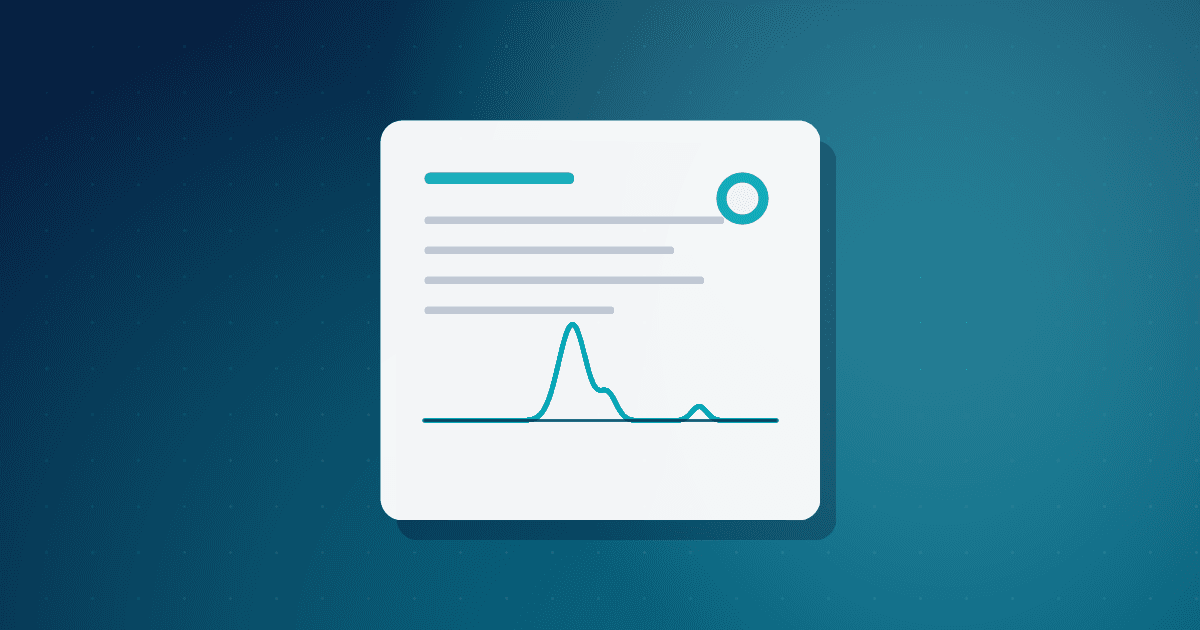


Purity is the number everyone compares, and the one that carries the least information on its own. Two lots can both report 98% by HPLC and behave differently in the same assay.
What the percentage is
It is the area of the main peak as a proportion of total peak area in the chromatogram, at a particular detection wavelength. Everything in that phrase is a qualifier.
Where the other two percent sits
This is the part the number hides:
- A close-eluting shoulder often means a closely related species, such as a deletion or oxidation product. It can be difficult to separate and may behave similarly enough to matter.
- Several small, well-separated peaks usually means unrelated minor impurities. Often less consequential.
- A rising baseline can indicate something not resolving at all.
Same headline figure, three different samples.
Detection has a wavelength
Peptide bonds are typically monitored around 214 nm; aromatic residues show at 280 nm. A species that absorbs poorly at the wavelength used contributes little peak area regardless of how much of it is present. This is why the method belongs on the certificate alongside the result.
Counterions and water are not impurities
Peptides are commonly supplied as salts, and lyophilised material holds residual water. Neither appears in an HPLC purity figure, but both affect how much peptide is actually in the vial. If your work depends on precise mass rather than relative comparison, ask about net peptide content.
What to do with this
Read the trace, record the lot, and compare like with like. When a result shifts unexpectedly between lots, the chromatograms are the first place to look and the reason we keep them.
We provide a Certificate of Analysis with every lot, and the underlying trace on request.